Skip to content

Indian frankincense

Boswellia serrata · salai gugul · the resin from the bark

In short

  • Part used: the resin that seeps out when the bark is cut, dried.
  • Grows: wild in dry forests and on dry hills in India.
  • Historical use: breathing and cough, wounds and skin, stomach and bowel, mouth and teeth, joints and pain.
  • Can be used for: no approved use in the EU. The World Health Organization considers use for arthritis, asthma and inflammatory bowel disease to be supported by clinical data.
  • Main substances: boswellic acids, tirucallic acids, essential oil and gum.
  • The research: most studies are on osteoarthritis of the knee. The reviews range from promising to too weak to say anything.
  • Suitable for: adults and children from 12 with arthritis, asthma or bowel inflammation, according to the WHO. Not for pregnant or breastfeeding women, or children under 12.
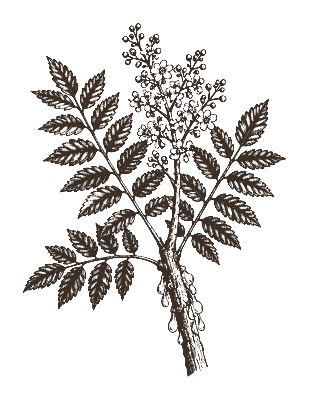
Line drawing of Indian frankincense

The Indian incense stayed at home

Arabia’s incense travelled. India’s stayed put.

An Indian reference book from 1889 tells of two kinds of incense.

One came with Arab traders, as early as the tenth century. The other seeps from the bark of a tree that grows on India’s dry hills. Over time the names of the two became so mixed up that they could no longer be told apart with certainty, the book says.

The Indian resin was used almost only in central and northern India, and was never exported. The author believed that everything written about its medicine probably applied to the imported kind. Little was known for certain about the Indian one.

Today it is the other way round. Indian frankincense is sold in the US and Europe, almost only as an extract.

Arabia got the fame. India got the research.

The plant

A tree that bleeds gold.

Indian frankincense is a deciduous tree that can grow 18 metres tall.

The bark is thick and fragrant, grey and flaky. The flowers are small and white. The fruit is three-sided, red when young and white when ripe.

When the bark is cut, a sap seeps out and sets in the air. Fresh, it is transparent, golden and semi-fluid, and it hardens slowly. A traveller in the hills of Bihar saw it flowing abundantly from the trunks, very fragrant and clear.

The tree grows in dry forests from Punjab to West Bengal and south across the peninsula. The Bhil people ate the flowers and nuts. The resin was burnt as incense in homes, especially at religious ceremonies.

The wrong plant in the bag

Pine in the bag, and an animal in the book.

Dioscorides taught his readers to expose fake incense.

Almost two thousand years ago he wrote that all incense was mixed with pine resin and gum. The test was fire. Gum does not catch fire, pine resin turns to smoke, but real incense burns and gives itself away by its scent. The Indian kind, he wrote, was made round on purpose: cut into cubes and rolled in clay jars until the pieces became round.

In 2016 researchers found signs of resin from the pine family in two of seven products sold as Indian frankincense. Another study found problems in 3 of 17 best-selling products. Where the resin has become scarce, bark or soil from under the tree has also been reported in place of resin. No one has studied how common the cheating is.

The Chinese sorted incense into many grades. According to the herbal from 1578, the best was round and transparent and was called “milk drops”. Further down the list came pieces mixed with sand and stone, and at the bottom, dust.

The names do not help. The 1889 reference book says that the Sanskrit name kunduru comes from Arabic and really belongs to the imported incense. The correct name is probably sallaki. But in the old Indian medical text Sushruta, sallaki can also be an animal. There, “hairs of sallaki” are burnt.

Historical use

Smeared on, breathed in, and now and then warned against.

So who used the resin, and for what?

Many old sources just say incense, without saying which tree it came from. The order is not a ranking. Where a source concerns incense from somewhere other than India, this is stated.

Breathing and cough

  • India, undated: the Indian pharmacopoeia lists difficult breathing.
  • The Arab world, around 1240: incense dissolved in water for phlegm, and to ease laboured breathing. The book says the incense came from Yemen and Oman.
  • India, 1889: as a stimulant in lung disease.
  • India, 1926: to loosen phlegm in bronchitis.

Wounds and skin

  • Greece, around AD 70: fills hollow wounds, helps them heal and stops bleeding. Dioscorides writes that the best came from Arabia.
  • China, 1578: for boils and all kinds of sores. China got its incense from India and Persia.
  • India, 1889: in ointment on sores and for skin diseases.
  • India, 1926: rubbed in with coconut oil or lemon juice on foul sores.
  • England, 1653: used outwardly on wounds, to fill hollow ulcers and stop bleeding.

Stomach and bowel

  • The Arab world, around 1240: stops diarrhoea and vomiting.
  • China, 1578: stops diarrhoea.
  • India, 1926: in long-lasting diarrhoea, dysentery and poor digestion.

Mouth and teeth

  • The Arab world, around 1240: chewed to strengthen the gums and teeth.
  • China, 1578: held in the mouth for bad breath, and chewed for toothache.
  • India, 1889: mixed with gum acacia for bad breath.
  • India, undated: the Indian pharmacopoeia lists diseases of the mouth.

Joints and pain

  • India, 1889: for rheumatism.
  • India, undated: the Indian pharmacopoeias list rheumatism and arthritis, according to the World Health Organization.
  • China, 1578: to still pain and stretch the sinews, and for fractures.
  • Disagreement: in animal experiments the resin had no pain-relieving effect in dogs, rabbits or rats, writes the World Health Organization.

The sources do not even agree on what kind of remedy it is. The Indian pharmacopoeia calls the resin warm. Nadkarni called it cooling in 1926. In the Chinese herbal it is listed both as slightly warm and non-toxic, and as hot and slightly toxic.

Can be used for

Nothing in the EU. Four things at the WHO.

Here the authorities disagree more than for most herbs.

  • EU: the EU food safety authority concluded in 2010 that it had not been shown that an extract contributes to normal joints. In 2002 a resin extract was given status as a possible medicine for a rare disease: swelling around brain tumours. The status was withdrawn in 2006 at the company’s request.
  • World Health Organization: arthritis, asthma, Crohn’s disease and ulcerative colitis, and it considers the use supported by clinical data. The pharmacopoeias list rheumatism and arthritis.
  • India: difficult breathing, fever, diseases of the mouth and several other complaints.
  • USA: the US National Center for Complementary and Integrative Health writes that there are not enough good studies to say whether it is useful for any condition.

So the World Health Organization and the American institute read the research very differently.

Who it suits

No answer from the EU. But the warnings look alike.

The EU has no approved use. So who does the resin suit, according to the others?

Who can use it

  • The authorities: adults and children from 12, says the WHO. The EU has no approved use, and so no age limit either.
  • Experience: rolv.no mentions rheumatic complaints, asthma and other airway complaints, and bowel inflammation such as ulcerative colitis and Crohn’s disease.
  • China: the Chinese pharmacopoeia lists boswellia resin for joint pain, period pain, pain in the stomach and chest, and injuries from blows and falls.
  • Research: most studies have been done in adults with osteoarthritis of the knee. Some have been done in adults with rheumatoid arthritis, bowel inflammation and asthma.

Who it doesn’t suit

  • Pregnant and breastfeeding women: the WHO advises against it, because there is too little knowledge about its safety. The Norwegian information centre RELIS writes that pregnant women should avoid it. The Chinese pharmacopoeia asks pregnant women to be careful with boswellia resin.
  • Children under 12: the WHO advises against it.
  • Allergy to the resin: the WHO says no.
  • Gastritis, reflux or a weak stomach: rolv.no advises caution. The Chinese pharmacopoeia says the same about people with a weak stomach.
  • Blood thinners: a large American cancer hospital writes that the resin can increase the risk of bleeding.
  • Medicines that suppress the immune system, and other regular medicines: RELIS writes that in the laboratory the resin inhibits enzymes that break down many medicines, and that in theory it can weaken medicines that suppress the immune system. No one knows whether this happens in the body.

Where the sources disagree

  • Pregnancy: an Indian medical book from 1926 writes that the resin brings on menstruation and labour. The Chinese herbal from 1578 uses incense at birth and in the last month of pregnancy. Today it is advised against in pregnancy.
  • Food or medicine: the US National Institutes of Health (NIH) writes that the amounts in food are probably safe, also for pregnant and breastfeeding women. Little is known about whether larger amounts as medicine are safe.
  • Safe or not: rolv.no considers it safe at recommended doses. The WHO still advises against it for pregnant and breastfeeding women and children.

What’s in the plant

More than one kind of acid.

What is in the resin?

  • Essential oil: five to nine per cent of the resin, mostly alpha-thujene.
  • Boswellic acids: more than twelve different ones. These are what is usually measured.
  • AKBA: the boswellic acid that most strongly inhibited the inflammatory enzyme 5-lipoxygenase in the laboratory.
  • Tirucallic acids: another group of acids. In an extract assessed by EFSA, there were more of them than of the boswellic acids.
  • Gum: turns the resin into a white, milky mass in water.

Which substance works?

What works in the test tube.

Many extracts are enriched in one substance. One of the most studied contains 30 per cent AKBA.

In the laboratory the boswellic acids block the enzyme that makes inflammatory substances. AKBA does it best.

In 2009 researchers looked at this more closely. In purified immune cells the acids worked well. In whole blood they did not. When the protein albumin was present, the effect disappeared, because more than 95 per cent of the acids bound to it. Healthy volunteers were given 800 milligrams of extract, but the inflammatory substance in their blood did not go down. The authors considered it doubtful that the effect means anything in the body.

The tirucallic acids pull the same way. The World Health Organization writes that one of them inhibited the enzyme without cells, but switched it on in whole cells.

The body also absorbs little of the boswellic acids. How much depends mainly on how the extract is made. With a high-fat meal, the amount in the blood was several times higher.

What stops the enzyme in a test tube does not necessarily do so in the blood.

What the research says

Promising, or too weak to say anything.

What happens when people actually take the resin?

In 2001, 20 people with long-standing bowel inflammation were given a preparation of whole resin for six weeks. Ten others were given the drug sulfasalazine. The disease settled in 14 of 20 on resin, against 4 of 10 on the drug.

In 2008, 75 people with osteoarthritis of the knee were given an extract enriched in AKBA, in two strengths, or placebo for 90 days. Both strengths gave less pain and better function. With the stronger one, the improvement came after only seven days.

In 1998 people with rheumatoid arthritis were given an extract or placebo for twelve weeks, on top of their usual treatment. Of 78 enrolled, only 37 could be assessed. The researchers found no measurable effect.

In 2011, 108 people with Crohn’s disease in remission were to take an extract or placebo for a year. The study was stopped early because there was no difference. The disease stayed quiet in 60 per cent on the extract and 55 per cent on placebo.

Cochrane reviewed herbs for osteoarthritis in 2014. Two studies with 85 participants gave high-quality data: an enriched extract lowered pain by 17 points on a scale from 0 to 100, compared with placebo.

A 2008 review of seven studies called the results encouraging but not compelling. A 2024 review of 13 knee studies found no clear effect overall, because the studies were so different. Against placebo alone, the effect was clear.

The US institute writes that most of the studies are small and of low quality.

Questions people ask

Can incense drive you mad?

Several old sources thought so.

Dioscorides wrote that healthy people who drank incense could go mad, and that a lot of it in wine could kill. Culpeper warned in 1653 against taking it inwardly, lest it cause madness. He recommended it only for outward use.

The Arabic medical book from 1240 says both. One author writes that incense dissolved in water refreshes the memory and sharpens the mind, but that too much causes headache. Another writes that it sometimes causes disturbances of the mind.

In 2024, 72 people with Alzheimer’s disease chewed gum with or without incense for 18 weeks. There was no difference in memory or thinking. Which tree the incense came from is not stated in the abstract.

Arabia’s was burnt. India’s was measured.

Sources

Authorities and monographs

  • WHO Monographs on Selected Medicinal Plants, vol. 4, 2009, Gummi Boswellii. iris.who.int
  • Ayurvedic Pharmacopoeia of India, part I, vol. IV, Kunduru. archive.org
  • EFSA FEEDAP 2022, olibanum extract from Boswellia serrata (quotes EFSA NDA 2010). pmc.ncbi.nlm.nih.gov
  • EMA, orphan designation EU/3/02/117, 2002–2006. ema.europa.eu
  • NCCIH, Boswellia. nccih.nih.gov
  • Chinese Pharmacopoeia 2020, boswellia resin (乳香), as given by ShennongAlpha. shennongalpha.westlake.edu.cn
  • MSKCC About Herbs, Boswellia, 2026. mskcc.org

Tradition and the plant

  • Watt, A Dictionary of the Economic Products of India, vol. 1, 1889. archive.org
  • Dioscorides, De Materia Medica, translated by Osbaldeston and Wood, 2000. archive.org
  • Ibn al-Baytar, Kitab al-Jami, French edition by Leclerc, vol. 3. archive.org
  • Li Shizhen, Bencao Gangmu, 1578. wikisource.org
  • Culpeper, Complete Herbal. archive.org
  • Nadkarni, Indian Materia Medica, 1926. archive.org
  • Sushruta Samhita, translated by Bhishagratna, vol. 3. archive.org
  • Urtekilden (Norwegian herb site), boswellia (quotes RELIS). rolv.no

Adulteration

  • ABC-AHP-NCNPR Botanical Adulterants Prevention Program, bulletin on Boswellia serrata, 2018 (quotes Meins 2016 and Niebler and Buettner 2016). herbalgram.org

Research

  • Siemoneit et al. 2009 (the enzyme in cells and blood). Europe PMC
  • Sterk et al. 2004 (absorption with and without food). Europe PMC
  • Gupta et al. 2001 (bowel inflammation, whole resin). Europe PMC
  • Sengupta et al. 2008 (osteoarthritis of the knee). Europe PMC
  • Sander et al. 1998 (rheumatoid arthritis). Europe PMC
  • Holtmeier et al. 2011 (Crohn’s disease). Europe PMC
  • Cameron and Chrubasik 2014, Cochrane (osteoarthritis). Europe PMC
  • Ernst 2008 (review of seven studies). Europe PMC
  • Dalmonte et al. 2024 (review, knee). Europe PMC
  • Ghorat et al. 2024 (Alzheimer’s disease). Europe PMC